
We live so many lifetimes inside one life.
In a past life of mine, I was a political reporter and Ann Widdecombe was in it.
Most of you know me now as a consultant who helps you get noticed, a writer and a mentor. Very few know the earlier version who hung out regularly at the House of Commons and along Whitehall – interviewing civil servants and minsters – the people who ran the country and, more to the point, the people who wanted to run it next!
It was a serious apprenticeship in a serious craft and I learned to read a room fast. I also learned that the story someone offers you is rarely the story worth having…
This is a previous life that is not digitised – there’s no web links or photos, no influencer photos or ‘social proof’
Because of the news last week, I dug out my old cuttings files and found this interview – I’ve written hundreds of stories, profiles and features, most of them would need a physical visit to the British Library for a copy!
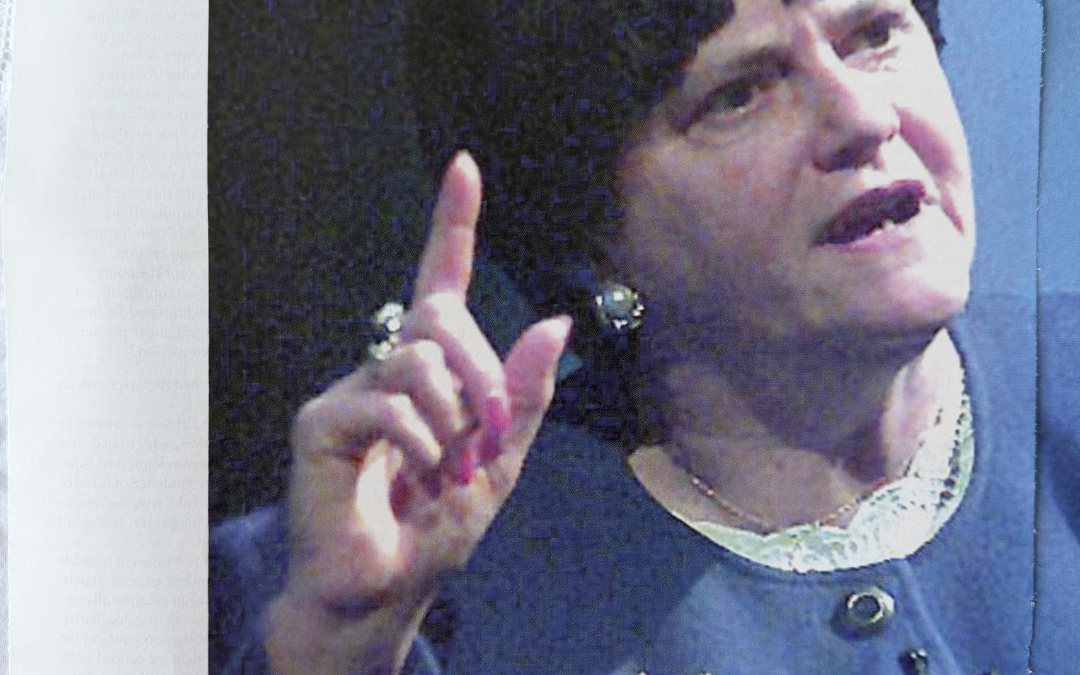
In 1999 I interviewed Ann Widdecombe for a profile. She was shadow health secretary then, already flattened by the press into a caricature – the pantomime villain in the tailored suit. My job was not to reprint the caricature, it was to go and find out what was actually there.
What I found was sharper and stranger than the cartoon: a politician entirely uninterested in being liked and unusually candid about the machinery of her own image.
She understood the game being played about her better than most of the people playing it.
I disagreed with her on nearly everything that mattered to me politically but that is not the point of an interview. The point is to render the person accurately enough that a reader meets them, not the stereotype – and she was a far more formidable subject than the columnists who reduced her ever let on.
That is the work I came up doing and it’s one of the reasons I read a pitch or a brief the way I do now – looking past the version that’s been polished for public consumption to the truer, more interesting story underneath. Journalism taught me that and Ann Widdecombe, among many others, taught me that.
It’s easy to forget how many lives a person has lived before the one you happen to be watching – this was one of mine.
You can read the full transcript below:
Mention Ann Widdecombe and the epithets come thick and fast. Her public persona is larger than life and not always flattering. She has been called Doris Karloff and variously described as pugnacious, intellectually brutal and matronly.
At home, she is a very different person. No boxy tailored suits here; she answers the door, barefoot and clothed in T-shirt and casual trousers. She sits on her pale green leather sofa with her feet curled under her, peach-painted toenails on show.
She is certainly forthright and plain-spoken. From her views on shackling pregnant prisoners to her opposition to abortion, she has spent many years hovering on the edges of moral fanaticism.
Today, she is a media darling. Like Labour’s Mo Mowlam, she has remained true to her own persona, won through and is now ‘fashionable’. As shadow health secretary, her image was transformed by a speech to the Tory party faithful where she disarmed her critics and made friends of the media.
She claims not to be conscious of her own image and says her head has not been turned by the recent attention. ‘I can’t work it out and it’s best that I don’t. My feet are on the ground but I am enjoying it. When you have had as bad a press as I used to, it is nice to see the other side. I am not so stupid to think it can’t change overnight’.
She believes the explanation is simple. ‘There is this lesson in it. The public are really fed up with spin and image and if they think that what they see is what they get, then they are relieved.’
There is a sensitive soul under the robust exterior. She does admit to being annoyed about what has been written about her, particularly whoever claimed she did not care about her image and appearance. ‘I have never said I don’t give a damn about what I look like. It is always necessary to be clean and tidy and appropriately dressed. I do find it irritating that everyone has started commenting on my tailored suits when I’ve worn them since I was 16.’
The no-nonsense, down-to-earth personality is fired up when the talk turns to politics. She rails against the government’s approach to the health service so far, dismissing their ‘tinkering’ with the Private Finance Initiative and accusing Frank Dobson of having his head in the sand.
With little Tory policy actually finalised, Widdecombe has been fleshing out some of the ideas and options available. An enthusiastic advocate of PFI, she is supremely dismissive of Labour’s attempts to use the PFI merely for buildings.
‘If you look at what we do on health, it is pretty pathetic, we simply do not go far enough. We all know that the NHS is relying on the private sector to help deliver the waiting-list initiative. Buildings PFI is no use because the government can always borrow more cheaply than the private sector. If you really want to get private sector resources put at the benefit of the NHS, then you don’t mess around with buildings, you have real provision of services.’
However, she does not think the health service needs the type of PFI makeover the Tories adopted for the prison service. ‘I am not saying I want to go as far as the prison service has, although from my previous incarnation I know what a huge success that is, such a huge success that Straw had to take it on.’
The latest Tory grand idea is the introduction of health service Tessas. Initially introduced by John Major, Tax Exempt Special Savings Accounts are currently being phased out in favour of Individual Savings Accounts. Widdecombe believes they could plug the gap between what people want from the health service and what the NHS can actually afford to provide. ‘I don’t want to make it compulsory but I do think we should look at ways to help those who want to take more responsibility for their own health.’
She blames the current health stalemate on a limited vision about private health insurance. ‘To most people private medicine means “Bloggs takes out an insurance policy”. But that is only a small part of it; 50% of users of private medicine do so under the corporate umbrella. If we could get employers to cover everyone from the director to the doorman, then it might be worthwhile looking at some kind of tax break.’
The justification for Tessas is that they allow people to save towards health care services as and when they need it. The beauty is that you can take the money if you do not need it, according to Widdecombe. ‘The health service cannot go on if it does not shed some of its load to the private sector.’
The thorny issue of waiting-list time is another policy being addressed by the shadow health team. Widdecombe is scathing about the current numbers-on-lists obsession.
‘We now have the ridiculous situation where there is a pre-pre-waiting list and we will not carry on with that.’ Instead, they intend to adopt the system recommended by the British Medical Association, which consists of one measurement of the time taken from GP referral until patients receive treatment with different waiting times for different conditions.
She remains to be convinced about the Primary Care Group approach but the Tories will not create more upheaval for an already overburdened health service. Instead, they will allow an orderly and voluntary return to GP fundholding.
The ideological pragmatism comes through with her justification of the problem of the postcode lottery, a frequent criticism of the fundholding regime. ‘If we don’t have a postcode lottery, then the alternative is uniform misery. If we do not increase private sector involvement in the NHS, then there will be an increasing number of treatments that people cannot get. I would rather some people could get it than no one gets it at all. It is simply not an argument.’
But away from the politics, there is another less well known side to her – that of a budding novelist. The shock of election defeat in 1997 left the former prisons minister with a lot of spare time, and she took to writing. Her first book, The Clematis Tree, is already set for publication and she has started on her second. ‘It was such a huge release to be on the backbenches, once I recovered from the shock. I could do exactly what I liked and I realised it could turn into a very bad habit so I indulged myself by writing. I will not give up politics but I do plan to have a retirement, unlike many of my colleagues who I think go on for too long. Now I know I can do something I enjoy.’
There is little room for relaxing in the Widdecombe diary but August is sacrosant, allowing the Maidstone MP to indulge her other passions – travel and swimming. She prefers far-flung destinations and in recent years has been to Malaysia, Singapore and Kenya.
The non-stop activity suggests a high-energy achiever but she disputes this. ‘I am actually extremely lazy. I would describe my life as a successful battle against laziness.’
THIS ARTICLE FIRST APPEARED IN PUBLIC FINANCE MAGAZINE IN JUNE 1999.
Recent Comments